

What Is the Difference Between Metric and SAE Hex Keys in 2026?
Quick Answer: Metric hex keys use millimeter measurements (1.5mm to 10mm commonly), while SAE hex keys use fractional inch measurements (1/16″ to 3/8″ typically). They are not interchangeable due to different sizing standards. Metric keys fit metric bolts and screws; SAE keys fit imperial fasteners. Using the wrong size can strip the fastener head or damage the tool. Always match your hex key to your fastener’s measurement system for proper fit and longevity.

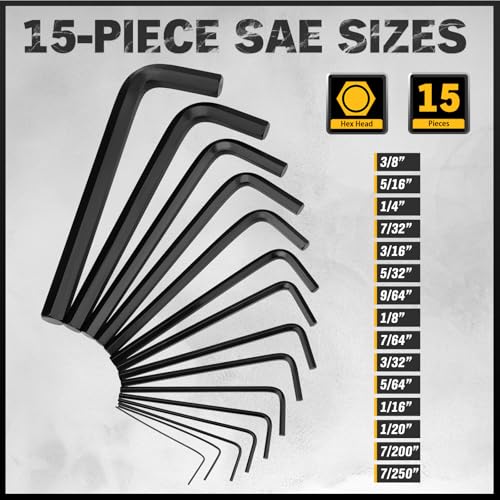
31-Piece Hex Key Set with Torque Handle & Carrying Case
- 【PREMIUM MATERIAL】 Heat-treated steel with black-oxide finish, featuring 15 long reach keys and 15 high leverage short keys for durability and strength.
- 【HIGH LEVERAGE】 Conventional drive end on both long and short keys allows for high leverage on stubborn fixings, ensuring efficient operation.
- 【TORQUE HANDLE】 Comes with a torque handle for added force during loading and unloading fasteners, increasing reach and enhancing torque performance.
- 【COMPLETE COVERAGE】 31-piece Allen wrench set with both inch and metric measurements, covering all hexagon socket screws for comprehensive use.
- 【EASY ORGANIZATION】 High-visibility size markings on each wrench and a sturdy carrying case for quick size selection and convenient storage.




As an Amazon Associate we earn from qualifying purchases. Product prices and availability are accurate as of the date/time indicated.
Hex keys, also called Allen wrenches or Allen keys, are L-shaped tools used to drive hexagonal socket-head screws and bolts. The distinction between metric and SAE versions stems from two different measurement systems used worldwide. Understanding this difference is critical for mechanics, DIY enthusiasts, and professional tradespeople who work with diverse fasteners. Choosing the correct type prevents damage to both tools and fasteners.
Key Takeaway: Metric and SAE hex keys differ in sizing standards and fastener compatibility—never assume interchangeability.
How Do Metric and SAE Hex Keys Differ in Size and Measurement?
Metric hex keys are sized in millimeters. Common sizes range from 1.5mm to 10mm, with increments of 0.5mm between smaller sizes. A 4mm metric hex key has a 4-millimeter width across the flats of the hexagon. SAE hex keys use fractional inch measurements like 1/16″, 5/64″, 3/32″, 1/8″, 5/32″, 3/16″, 7/32″, 1/4″, 5/16″, and 3/8″.
The two systems do not align mathematically. A 5mm metric hex key is not equivalent to a 3/16″ SAE hex key, even though both are close in physical size. Attempting to use one for the other results in a loose fit or, worse, stripping the fastener’s socket. This incompatibility makes it essential to identify your fastener’s origin before selecting a tool.
Common Metric Hex Key Sizes
- 1.5mm – small electronics and precision instruments
- 2mm – compact fasteners and consumer products
- 2.5mm – general-purpose small bolts
- 3mm – automotive and industrial applications
- 4mm – common in machinery and furniture
- 5mm – larger industrial fasteners
- 6mm – heavy-duty equipment and construction
- 8mm – large bolts in automotive work
- 10mm – industrial and agricultural equipment
Common SAE Hex Key Sizes
- 1/16″ – small fasteners in electronics
- 5/64″ – precision instruments
- 3/32″ – general small bolts
- 1/8″ – common in machinery
- 5/32″ – mid-range fasteners
- 3/16″ – automotive and industrial use
- 1/4″ – heavy-duty applications
- 5/16″ – large bolts in construction
- 3/8″ – maximum standard size
Key Takeaway: Metric sizes are in millimeters; SAE sizes are in fractional inches—they do not convert directly.
Which Fasteners Require Metric Versus SAE Hex Keys?
Metric hex keys fit fasteners manufactured to metric specifications. European, Asian, and most modern international products use metric fasteners. If a bolt or screw is labeled with millimeter dimensions, it requires a metric hex key. Metric fasteners are standard in automotive parts from European manufacturers, industrial machinery, and modern consumer electronics.
SAE hex keys are designed for fasteners measured in imperial units. American-made products, older equipment, and legacy systems predominantly use SAE fasteners. Many automotive applications in North America, older machinery, and traditional hand tools rely on SAE hex keys. Mixing these systems on a single project is common when working with imported or refurbished equipment.
Product Origins and Fastener Types
- Metric fasteners: European cars, Japanese motorcycles, IKEA furniture, modern power tools
- SAE fasteners: American vehicles, vintage tools, legacy industrial equipment, traditional machinery
- Mixed systems: Imported vehicles with domestic modifications, hybrid equipment, restoration projects
Identifying the correct fastener type is straightforward: check the product manual or measure the socket width with calipers. If measurements are in millimeters, use metric hex keys. If marked in fractions or inches, use SAE keys. Many professional toolkits include both systems to handle diverse projects.
Key Takeaway: Match your hex key system to your fastener’s origin and measurement standard.
What Are the Practical Consequences of Using the Wrong Hex Key?
Using an incorrect hex key size causes immediate problems. A too-small key will not engage properly and may slip inside the socket, stripping the fastener’s hexagonal shape. A too-large key cannot fit at all or forces entry, damaging both the tool and the bolt head. Either scenario compromises the fastener’s integrity and may require drilling out the bolt to remove it.
Stripped fasteners are expensive to fix. In automotive work, a damaged bolt in an engine block or suspension component may require partial disassembly. In electronics, a stripped screw can render a device unrepairable without professional intervention. Prevention through proper tool selection is far more cost-effective than repair.
Signs You’re Using the Wrong Hex Key
- The key sits loosely in the fastener socket
- Excessive force is needed to turn the key
- The key slips or rotates without moving the fastener
- You hear grinding or cracking sounds
- The fastener head shows visible damage or deformation
Stop immediately if you notice any of these signs. Remove the key, inspect the fastener, and select the correct size. Continuing with an improper fit will cause permanent damage. For seized or stubborn fasteners, apply penetrating oil and wait before attempting again with the correct key.
Key Takeaway: Wrong-sized hex keys strip fasteners—always verify size before applying force.
How Should You Build a Complete Hex Key Set for 2026?
A professional-grade toolkit should include both metric and SAE hex keys in all common sizes. Most mechanics and serious DIYers maintain separate sets to avoid confusion. Budget-conscious users can start with a combination set that includes both systems in one organizer. Quality matters: hardened steel hex keys resist bending and stripping better than cheaper alternatives.
Storage and organization prevent lost tools and ensure quick access. Many hex key sets come in folding organizers or magnetic holders that keep keys sorted by size. Label your sets clearly if mixing metric and SAE in the same workspace. Digital calipers or a sizing gauge can help identify unknown fasteners quickly on the job.
Recommended Hex Key Set Contents
- Metric set: 1.5mm, 2mm, 2.5mm, 3mm, 4mm, 5mm, 6mm, 8mm, 10mm
- SAE set: 1/16″, 5/64″, 3/32″, 1/8″, 5/32″, 3/16″, 1/4″, 5/16″, 3/8″
- Material: Chrome-plated or hardened steel for durability
- Storage: Folding organizer or magnetic holder for easy access
- Extras: Ball-end hex keys for angled access, long-shaft versions for deep sockets
Specialty hex keys serve specific purposes. Ball-end keys allow driving fasteners at angles up to 25 degrees, useful in tight spaces. Extra-long shaft keys reach recessed fasteners. T-handle versions provide better grip and leverage for stubborn bolts. Consider your typical projects when selecting specialty tools.
Key Takeaway: Maintain separate metric and SAE sets with clear labeling and organized storage.
Recommended Products
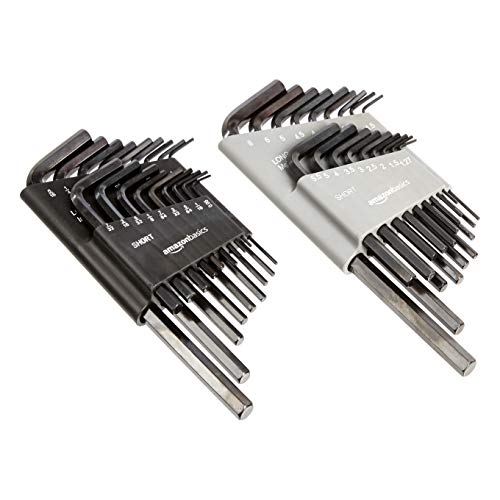
Amazon Basics 36-Piece Allen Wrench/Hex Key Set, SAE & Metric Sizes, Chrome Vanadium Steel with Long Arm, 2 Organized Storage Cases
- Allen wrenches (aka hex keys) for tightening or loosening screws
- Includes 36 hex keys in SAE and metric sizes and with long and short arm lengths
- Made of durable chrome vanadium steel with a black oxide finish for rugged strength and rust resistance
- 2 hinged cases included, complete with dedicated slots for key storage and clear size markings for fast locating
- Ideal for working on bicycles, motorcycles, vehicles, furniture, machinery, and more
- Product dimensions: 7.40 x 3.39 x 1.65 inches (LxWxH)


As an Amazon Associate we earn from qualifying purchases. Product prices and availability are accurate as of the date/time indicated.

Kraftek toolant 14PCS Folding Allen Wrenches Sets, Metric Allen Key Set 2mm- 6mm, SAE Hex Key Set 5/64”- 1/4", CRV Steel EDC Tool for Bike Repair & Home,Compact Foldable Hex Key Set
- Folding allen wrench set Perfect Gift for Dad,Friends, Husband, DIYer.Fathers day gifts for him,christmas gifts for him.It is a good bottle opener.
- Every Size You Need: Includes 14 different sizes. 7 SAE Allen Keys Sets: 5/64”, 3/32”, 1/8”, 5/32”, 3/16”, 7/32”, 1/4"and 7 Metric hex keys: 2mm, 2.5mm, 3mm, 4mm, 4.5mm, 5mm, 6mm
- Easy To Store And Carry(EDC):Compact case and light-duty design, which is suitable for your" on-the-go" project
- Precision Machining: Hex-key ends are square-cut for a secure, full-depth fit and maximum contact with the socket to prevent slippage and stripping
- Convenient Folding Design:Foldable design of the foldable hexagonal wrench kit has a special flexible angle, which can be used in different occasions. After separation, it can also be used as a bottle opener
- Alloy steel material provides high torsion strength: Wrench body is made of special alloy steel (CRV) to optimize the balance between hardness and toughness with the HRC rating of 58 to 62


As an Amazon Associate we earn from qualifying purchases. Product prices and availability are accurate as of the date/time indicated.
Frequently Asked Questions
Can You Use a Metric Hex Key on an SAE Fastener?
No. While some sizes may appear similar, metric and SAE hex keys do not fit interchangeably. A 5mm metric key is slightly smaller than a 3/16″ SAE key. Forcing a metric key into an SAE fastener will strip the socket and damage the tool. Always use the correct system.
How Do You Identify Whether a Fastener Is Metric or SAE?
Check the product manual or measurement markings first. If unavailable, use digital calipers to measure the socket width. Metric measurements are in millimeters; SAE measurements are in fractional inches. Test-fit a hex key from each system—the correct size will fit snugly without excessive force.
Are Metric Hex Keys Stronger Than SAE Hex Keys?
Material and manufacturing quality determine strength, not the measurement system. A hardened steel metric key is stronger than a cheap SAE key. Both systems are available in standard and premium grades. Purchase high-quality tools from reputable manufacturers regardless of system type.
What Is the Most Common Hex Key Size in Each System?
In metric, the 4mm and 5mm hex keys are most common in consumer products and automotive work. In SAE, the 3/16″ and 1/4″ sizes dominate industrial and automotive applications. Building a complete set ensures you’re prepared for most projects.
Do Ball-End Hex Keys Work with Both Metric and SAE?
Yes. Ball-end hex keys are available in both metric and SAE sizes. The ball-end design allows angled access but does not change the sizing system. Select ball-end keys in the specific sizes you need for your fasteners.
Why Do Some Countries Use Metric and Others Use SAE?
Historical development and industrial standards created these divisions. The United States adopted imperial measurements; most other nations adopted the metric system. Modern globalization blends both systems, making dual-system knowledge essential for international work and imported products.
Which Hex Key System Should You Prioritize for Your Toolkit in 2026?
Your priority depends on your location and typical projects. North American technicians working primarily on domestic vehicles and equipment should prioritize SAE hex keys. However, modern vehicles increasingly incorporate metric fasteners, so both systems are valuable. If you work on imported products, European equipment, or IKEA-style furniture, metric keys are essential.
The most practical approach is building a comprehensive toolkit with both systems. Many professional sets now include both metric and SAE keys in organized holders, eliminating guesswork. Start with the system most relevant to your primary projects, then expand to include the other as your work diversifies. Investing in quality tools from trusted manufacturers ensures reliability and longevity.
Related topics like socket drive systems and fastener compatibility deepen your mechanical knowledge. Understanding the differences between 1/4, 3/8, and 1/2 drive sockets complements hex key knowledge. For more on fastener types, explore Phillips and Torx screwdriver differences. Building a well-rounded toolkit takes time but pays dividends in project success and tool longevity.
Key Takeaway: Invest in both metric and SAE hex key sets appropriate to your geographic region and typical projects.



Write Your Review
No reviews yet. Be the first to share your experience!